Internal Combustion Engines
So, first of all this post is extremely simple and I’m fairly sure that most people are already aware of these. I’m posting this for future reference on more advanced concepts and redesigns of core components used in modern cars. Here, I’ll try to demonstrate the simplest possible 4-stroke internal combustion engine in order to be understandable even by people with no prior knowledge.
Warning: As you’ll see in future posts, the engine I’m discussing here has very little in common with the engines found in modern vehicles apart from the general operation principles.
That said, let’s start this… As a general unofficial rule, in internal combustion engines air (more specifically oxygen) + fuel = power. With this in mind let’s have a look at the image below.

Cylinder’s Displacement
What you can see at a glance is that this is a 4 cylinder engine. The cylinder’s displacement is what you commonly hear as a 3.2L, 3.200cc, 195.3ci in liters, cubic centimeters and cubic inches. In fact, this is the swept volume of a cylinder multiplied by the total amount of cylinders.
Intake/Exhaust Valve(s)
Now locate at the left of the image the intake valve. As you can see, this is controlled by intake camshaft which in real life looks more like this.

As it rotates it forces some valves to open and others to remain closed. For better understanding here is a figure that demonstrates this.

Of course, valves have springs to return to their original position when not pushed down. If you have a look at the end of the camshaft you will notice that it has a gear. This is driven with a belt (known as cambelt) using the rotating crankshaft at the lower part of the engine. Here is a photograph where hopefully, you will be able to identify the discussed parts.

Similarly to the intake camshaft and valves you can locate at the opposite side of the cylinder the exhaust camshaft and valves. As you have probably already guessed, the intake opens to fill the combustion chambers of the cylinders with the mixture (fuel + air) while the exhaust opens after the combustion to release the exhaust gas from the chambers. This means that valve timing is crucial since valves should be consistent.
Crankshaft
In the previous paragraph I talked about the rotating crankshaft. Check out the first image again to locate the crank at the lower part of the engine that holds the pistons with the connecting rods and has a flywheel at one of its end. Assuming that two of the four pistons are compressing the mixture inside the chamber (such as the first image’s chambers 1 and 4), when the spark plug will ignite the mixture the pressure from this “explosion” will force those two pistons move downwards while the middle two will have an opposing movement since they were already down. This is what makes the engine running and the crankshaft rotating giving us the ability to connect it to wheels and roll. In most vehicles I have seen, what you see as the RPM indicator (revolutions per minute) on your dashboard, is the rotation of the above mentioned crankshaft.
Clutch (Transmission)
With the above knowledge you should be frustrated by now. If the engine’s crankshaft doesn’t stop moving as long as the engine is running then why isn’t the car moving all the time? The answer is because at the the end of the flywheel which is there to transfer the power from the crankshaft to the wheels is another part named clutch (and gearbox that we’ll discuss next).
There are numerous different types of clutches for both manual and automatic gearboxes. The most simple is the one you see here:

As you can see from the figure, it is attached to the end of the flywheel which is constantly rotating. When the clutch is pressed, the pressure plate pushes the clutch disc and thus moves it away from the flywheel so that the power isn’t transfered. Of course, after some time (or truly bad use of it), the clutch will be damaged by the friction during this connection/disconnection and it’ll need to be replaced. The aim of the clutch is to allow us disconnect the crankshaft, select a gear appropriate to produce the RPMs and torque we need and then reconnect it. This moves us the the next part…
Gearbox (Transmission)
By now, you should know that clutch is between the engine’s flywheel and gearbox to separate them when necessary. A gearbox is nothing more than what it’s name suggests. A box of gears which could be either automatic (using various technologies such as hydraulic systems to select the right gear and push/pull the clutch), or manual. Here is a simple gearbox to get you started.

When the selector is set to neutral the layshaft will rotate (at the same RPMs as the crankshaft) but there will be no gear connected to it to transfer the movement to the wheels (ignore that differential mentioned in the figure for the moment). Hopefully, you’ll know from school that when you connect a smaller gear to a larger one it will rotate at less RPM and of course the larger transferring power to a smaller will have the opposite result. That’s the whole concept behind transmission here. So, depending on the driver’s selection the transmission can provide the required RPMs and torque. The reverse gear is nothing really special. If a gear is rotating clockwise and you connect another gear on it, the latter will rotate counter-clockwise. Consequently, to have reverse the only thing you have to do is insert another gear between layshaft’s gear and the 1st gear (although the diagram shows otherwise this is how it’s done in most vehicles).
4-stroke
Now that you hopefully have a very general idea of how an engine works let’s have a look at the most important part for most modern vehicles. Their engine operation is named 4-stroke because the engine does a cycle of tasks which is separated in 4 stages.
1: Intake Stroke
The piston moves downwards and the intake valve(s) opens up to fill the chamber with the mixture (fuel + air) while the exhaust valve(s) are closed. Here is a figure for better understanding.

When the piston reaches the lowest position the intake valve(s) will start closing (because of the camshaft’s rotation and the springs shown above).
2: Compression Stroke
During this stroke, the cylinder looks like this:

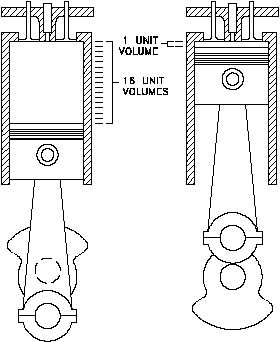
Both intake and exhaust valves are closed and the piston compresses the mixture. It’s very common among performance tuning communities to hear about the ideal compression ratio to have the best possible ignition. Compression ratio is the the difference between:
a) The volume of the cylinder (and combustion chamber) when the piston is at the bottom
b) The volume of the cylinder (and combustion chamber) when the piston is at the top
Here is a nice diagram to understand this:

The wikipedia article on compression ratio (you can find it here) has a nice and simple example which I’ll paste here:
Picture a cylinder and its combustion chamber with the piston at the bottom of its stroke containing 1000 cc of air (900 cc in the cylinder plus 100 cc in the combustion chamber). When the piston has moved up to the top of its stroke inside the cylinder, and the remaining volume inside the head or combustion chamber has been reduced to 100 cc, then the compression ratio would be proportionally described as 1000:100, or with fractional reduction, a 10:1 compression ratio.
So, assuming that we have reached the top of the combustion chapter we can move to the next stroke.
3: Power Stroke
Once again, both intake and exhaust valves are closed and the piston is at the top of the combustion chamber. The third stroke is when the spark plug ignites the mixture.

Of course, here is important to have a homogeneous mixture of fuel/air to have the best ignition. The pressure from the released exhaust gases of this ignition will force the piston move downwards. Earlier in this post, I said “explosion”. I put this in quotes because I wanted to explain this here. In fact, this is a fast, uniform burn of the mixture. Not an actual explosion. As you probably already know, in order to have ignition you need to have oxygen. This is why the air/fuel ratio is so important (and many of the most common performance tunings (superchargers, turbo, nitrous oxide, aftermarket air filters, etc.) have to do with providing higher quality mixture). The most common representation of this ratio is using lambda (λ) representation but I’ll talk about this in detail in future blog posts. If you want to learn more, you can always read wikipedia.
4: Exhaust Stroke
If you have a look at the first engine’s diagram you’ll notice that two of the four cylinders are down while the others are on top. This is done to provide a consistent operation since the intake (stroke one) and the exhaust (stroke four) strokes move the pistons with the power of the crankshaft which is moved by the other two cylinders that are giving power to it.

Now, as you’ve been expecting. With the power of its neighbor cylinder(s) that moves the crankshaft, the piston that just passed the third stroke will start moving upwards and the exhaust valve (using the camshaft’s timing) will open to release the exhaust gases from the previous ignition.
This 4-stroke cycle continues as long as air/fuel mixture is provided to the engine. Here is an animated image that will hopefully be understandable by now.

These are the principles of 4-stroke engine’s operation which are the most widely used in cars and modern bikes.
Warning: As you’ll see in future posts, the engine I’m discussing here has very little in common with the engines found in modern vehicles apart from the general operation principles.
That said, let’s start this… As a general unofficial rule, in internal combustion engines air (more specifically oxygen) + fuel = power. With this in mind let’s have a look at the image below.
Cylinder’s Displacement
What you can see at a glance is that this is a 4 cylinder engine. The cylinder’s displacement is what you commonly hear as a 3.2L, 3.200cc, 195.3ci in liters, cubic centimeters and cubic inches. In fact, this is the swept volume of a cylinder multiplied by the total amount of cylinders.
Intake/Exhaust Valve(s)
Now locate at the left of the image the intake valve. As you can see, this is controlled by intake camshaft which in real life looks more like this.

As it rotates it forces some valves to open and others to remain closed. For better understanding here is a figure that demonstrates this.

Of course, valves have springs to return to their original position when not pushed down. If you have a look at the end of the camshaft you will notice that it has a gear. This is driven with a belt (known as cambelt) using the rotating crankshaft at the lower part of the engine. Here is a photograph where hopefully, you will be able to identify the discussed parts.

Similarly to the intake camshaft and valves you can locate at the opposite side of the cylinder the exhaust camshaft and valves. As you have probably already guessed, the intake opens to fill the combustion chambers of the cylinders with the mixture (fuel + air) while the exhaust opens after the combustion to release the exhaust gas from the chambers. This means that valve timing is crucial since valves should be consistent.
Crankshaft
In the previous paragraph I talked about the rotating crankshaft. Check out the first image again to locate the crank at the lower part of the engine that holds the pistons with the connecting rods and has a flywheel at one of its end. Assuming that two of the four pistons are compressing the mixture inside the chamber (such as the first image’s chambers 1 and 4), when the spark plug will ignite the mixture the pressure from this “explosion” will force those two pistons move downwards while the middle two will have an opposing movement since they were already down. This is what makes the engine running and the crankshaft rotating giving us the ability to connect it to wheels and roll. In most vehicles I have seen, what you see as the RPM indicator (revolutions per minute) on your dashboard, is the rotation of the above mentioned crankshaft.
Clutch (Transmission)
With the above knowledge you should be frustrated by now. If the engine’s crankshaft doesn’t stop moving as long as the engine is running then why isn’t the car moving all the time? The answer is because at the the end of the flywheel which is there to transfer the power from the crankshaft to the wheels is another part named clutch (and gearbox that we’ll discuss next).
There are numerous different types of clutches for both manual and automatic gearboxes. The most simple is the one you see here:

As you can see from the figure, it is attached to the end of the flywheel which is constantly rotating. When the clutch is pressed, the pressure plate pushes the clutch disc and thus moves it away from the flywheel so that the power isn’t transfered. Of course, after some time (or truly bad use of it), the clutch will be damaged by the friction during this connection/disconnection and it’ll need to be replaced. The aim of the clutch is to allow us disconnect the crankshaft, select a gear appropriate to produce the RPMs and torque we need and then reconnect it. This moves us the the next part…
Gearbox (Transmission)
By now, you should know that clutch is between the engine’s flywheel and gearbox to separate them when necessary. A gearbox is nothing more than what it’s name suggests. A box of gears which could be either automatic (using various technologies such as hydraulic systems to select the right gear and push/pull the clutch), or manual. Here is a simple gearbox to get you started.
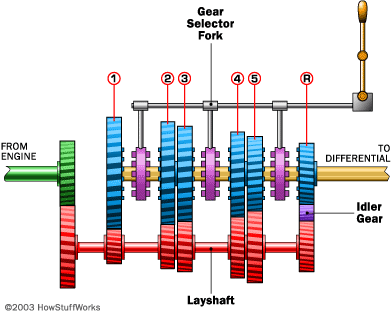
When the selector is set to neutral the layshaft will rotate (at the same RPMs as the crankshaft) but there will be no gear connected to it to transfer the movement to the wheels (ignore that differential mentioned in the figure for the moment). Hopefully, you’ll know from school that when you connect a smaller gear to a larger one it will rotate at less RPM and of course the larger transferring power to a smaller will have the opposite result. That’s the whole concept behind transmission here. So, depending on the driver’s selection the transmission can provide the required RPMs and torque. The reverse gear is nothing really special. If a gear is rotating clockwise and you connect another gear on it, the latter will rotate counter-clockwise. Consequently, to have reverse the only thing you have to do is insert another gear between layshaft’s gear and the 1st gear (although the diagram shows otherwise this is how it’s done in most vehicles).
4-stroke
Now that you hopefully have a very general idea of how an engine works let’s have a look at the most important part for most modern vehicles. Their engine operation is named 4-stroke because the engine does a cycle of tasks which is separated in 4 stages.
1: Intake Stroke
The piston moves downwards and the intake valve(s) opens up to fill the chamber with the mixture (fuel + air) while the exhaust valve(s) are closed. Here is a figure for better understanding.

When the piston reaches the lowest position the intake valve(s) will start closing (because of the camshaft’s rotation and the springs shown above).
2: Compression Stroke
During this stroke, the cylinder looks like this:

Both intake and exhaust valves are closed and the piston compresses the mixture. It’s very common among performance tuning communities to hear about the ideal compression ratio to have the best possible ignition. Compression ratio is the the difference between:
a) The volume of the cylinder (and combustion chamber) when the piston is at the bottom
b) The volume of the cylinder (and combustion chamber) when the piston is at the top
Here is a nice diagram to understand this:
The wikipedia article on compression ratio (you can find it here) has a nice and simple example which I’ll paste here:
Picture a cylinder and its combustion chamber with the piston at the bottom of its stroke containing 1000 cc of air (900 cc in the cylinder plus 100 cc in the combustion chamber). When the piston has moved up to the top of its stroke inside the cylinder, and the remaining volume inside the head or combustion chamber has been reduced to 100 cc, then the compression ratio would be proportionally described as 1000:100, or with fractional reduction, a 10:1 compression ratio.
So, assuming that we have reached the top of the combustion chapter we can move to the next stroke.
3: Power Stroke
Once again, both intake and exhaust valves are closed and the piston is at the top of the combustion chamber. The third stroke is when the spark plug ignites the mixture.

Of course, here is important to have a homogeneous mixture of fuel/air to have the best ignition. The pressure from the released exhaust gases of this ignition will force the piston move downwards. Earlier in this post, I said “explosion”. I put this in quotes because I wanted to explain this here. In fact, this is a fast, uniform burn of the mixture. Not an actual explosion. As you probably already know, in order to have ignition you need to have oxygen. This is why the air/fuel ratio is so important (and many of the most common performance tunings (superchargers, turbo, nitrous oxide, aftermarket air filters, etc.) have to do with providing higher quality mixture). The most common representation of this ratio is using lambda (λ) representation but I’ll talk about this in detail in future blog posts. If you want to learn more, you can always read wikipedia.
4: Exhaust Stroke
If you have a look at the first engine’s diagram you’ll notice that two of the four cylinders are down while the others are on top. This is done to provide a consistent operation since the intake (stroke one) and the exhaust (stroke four) strokes move the pistons with the power of the crankshaft which is moved by the other two cylinders that are giving power to it.

Now, as you’ve been expecting. With the power of its neighbor cylinder(s) that moves the crankshaft, the piston that just passed the third stroke will start moving upwards and the exhaust valve (using the camshaft’s timing) will open to release the exhaust gases from the previous ignition.
This 4-stroke cycle continues as long as air/fuel mixture is provided to the engine. Here is an animated image that will hopefully be understandable by now.
These are the principles of 4-stroke engine’s operation which are the most widely used in cars and modern bikes.

